10-minute read · Money Conversations + Activities
Key Takeaways
- Pick a real business your kid sees every week — the daycare, the coffee shop, the trampoline park. Abstract examples don’t land; familiar ones do.
- Use four numbers: revenue (money in), costs (money out), profit (revenue minus costs), profit margin (profit divided by revenue, as a percent). That’s it. That’s a whole business education.
- Let your kid guess each number first. Their wrong guesses are the lesson. A six-year-old guessing daycare costs $50,000/year and being told it’s $1.5M is the moment money becomes real.
- For 7+ kids, add valuation — businesses are worth roughly 3× their yearly profit. Suddenly your kid understands why parents buy houses, why companies go public, and why Warren Buffett is famous.
A few mornings ago, my six-year-old son Ari asked me how his little sister’s daycare makes money.
Not “do they make money.” How.
I asked him what he thought. He guessed that parents pay maybe $50 a year, and the daycare uses it for crayons. Then he asked how many kids go. Then he asked how the teachers eat. Then he asked if the building was free.
He was — in his own six-year-old way — doing market research and unit economics. And he didn’t need me to explain those terms. He needed me to show him the math.
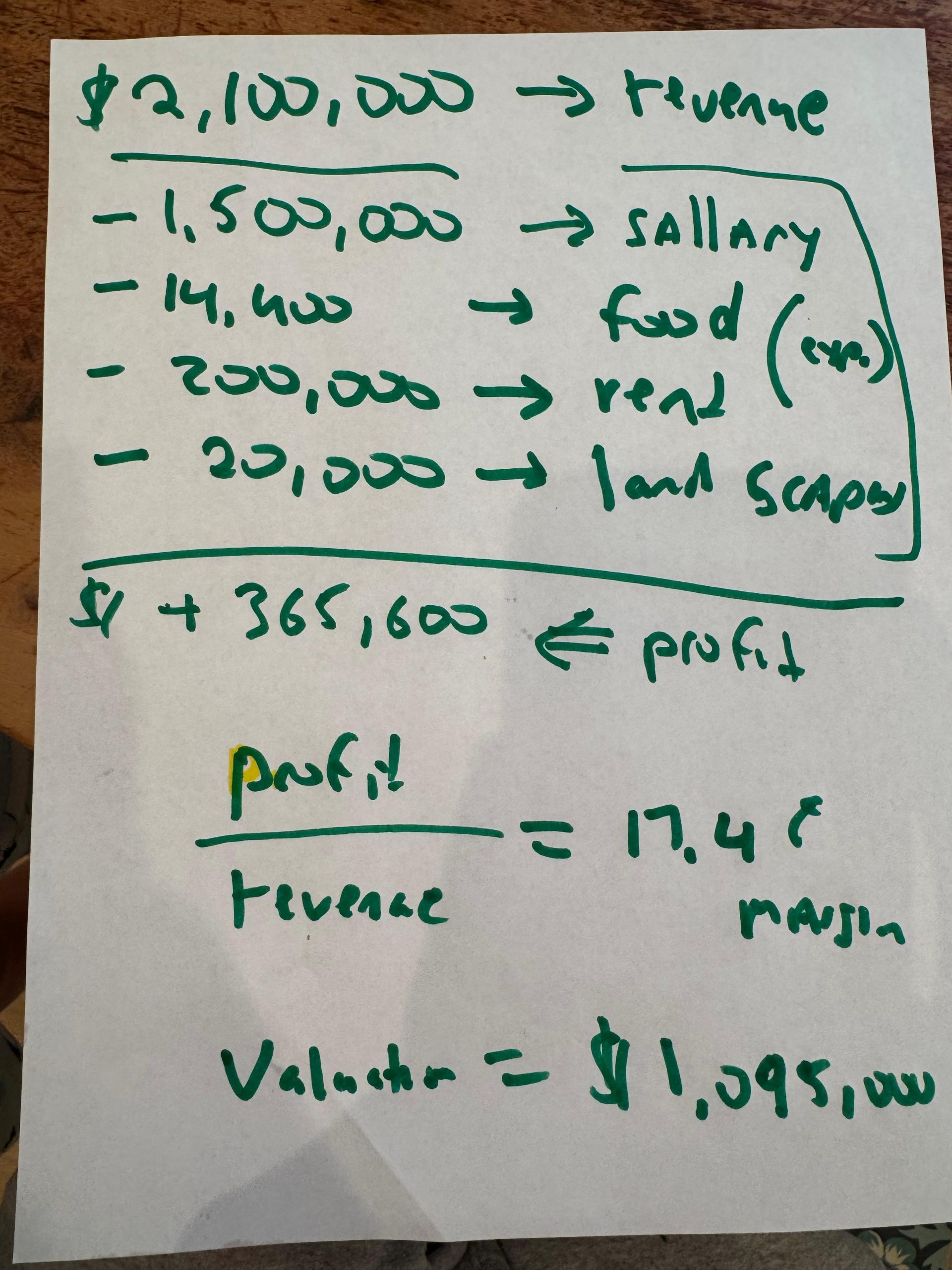
So I grabbed a piece of paper and we sketched it out together. Revenue. Costs. Profit. Profit margin. And, because he kept asking, a rough valuation of the daycare. The whole thing took fifteen minutes.
At the end of it he said: “So the lady who owns it makes $365,000 a year?”
Yes, roughly.
“And if she sold it, she’d get a million dollars?”
About that, yeah.
“That’s a lot of crayons.”
Right.
I want to share that whole conversation with you, because it’s the single most underrated thing you can teach a kid about money — and almost no parent does it. Most money education for kids is about saving allowances. Useful, but it’s the smallest possible lens. The bigger lens is this: every place you take your kid is a business, running the same math, making the same decisions, and that math is shockingly simple.
If your kid can grasp these four numbers by age 8, they’ll spend their adult life thinking about money in a fundamentally different way than the kids who didn’t.
Here’s how to do it.
The four numbers every business runs on
You don’t need a textbook. You don’t need a spreadsheet. You don’t need MBA vocabulary. You need four numbers and the willingness to be wrong with your kid for the first three guesses.
1. Revenue — the money coming in
Pick a real business. The closer to your kid’s life the better. For us it was Zoe’s daycare. For yours it might be:
- The coffee shop you stop at on the way to school
- The pizza place you order from on Fridays
- The trampoline park where you had a birthday party
- The pediatrician’s office
- A YouTube channel your kid watches
Then you ask: how much money do you think this place makes every year?
This is the magic step. Don’t tell them the answer. Let them guess.
Ari guessed $50. I asked him to think bigger. He went to $5,000. I told him to think bigger still. He looked at me like I’d lost my mind.
When we worked it out — the daycare has roughly 70 kids, each family pays about $30,000 a year — the number came out to about $2,100,000.
Two-point-one million dollars. A year. For a daycare.
The look on his face is what financial literacy actually feels like, by the way. It’s not a feeling of understanding numbers. It’s a feeling of the world is bigger than I thought, and adults are not magic, they’re just doing math I can do too.
2. Costs — the money going out
Now you ask: what does this business have to pay for?
This is where a six-year-old turns into a surprisingly good business analyst. Ari listed:
- The teachers (he correctly intuited that this was the biggest one)
- Food for the kids
- The building (rent)
- “And someone cuts the grass”
Together we put numbers next to each. I helped him reason — there are maybe 15 staff members; teachers in our area make around $100,000 once you include benefits and taxes and overtime. Food for 70 kids over 200 days at $1 a kid is $14,000. Rent for a building that size is probably $200,000 a year. Landscaping, maintenance, supplies — call it $20,000.
Total: about $1,734,400 going out per year.
The numbers don’t have to be perfectly right. The point is the shape of the math, not precision. Your kid will catch on to “the biggest cost is the people” and that lesson alone is most of what they need to know about how businesses work for the next decade.
3. Profit — what’s left over
This is the easy part, mathematically. But conceptually it’s where most adults’ money education stops, which is a shame, because the next number is the one that explains the modern economy.
Profit = Revenue – Costs.
For the daycare: $2,100,000 – $1,734,400 = $365,600.
Ari, when he saw this number, said: “Wait, the lady who owns the daycare actually keeps that money?”
Yes. (Minus taxes — but we’ll save that for later.)
“Why?”
Because she’s the owner. Because she took the risk of opening it. Because if it had gone badly she’d have lost her money instead.
This is the conversation. This single back-and-forth — why does the owner get the profit? — is the doorway to everything else: stocks, dividends, real estate, entrepreneurship. Every kid eventually asks this question. Most parents don’t have a good answer ready.
The good answer is: the owner takes the risk, so the owner gets the reward. If you want a piece of the reward, you have to take a piece of the risk — by starting a business, or by owning a piece of someone else’s business (a stock).
If your kid is around 6-8, this is also a great moment to mention that you can buy a tiny piece of giant businesses through stocks. We have a whole section of our free workbook that walks through stocks and dividends for kids ages 6+ — it’s free, it pairs with the picture book, and we send it instantly to your inbox.
4. Profit margin — the secret fourth number
This is the one most parents skip, and most kids find delightful once they get it.
Profit margin = Profit ÷ Revenue, as a percentage.
For the daycare: $365,600 ÷ $2,100,000 = 17.4%.
This is the number that tells you how good a business is at being a business.
Why does it matter? Because for any given revenue, a higher margin means more money for the owner. And different industries have wildly different “normal” margins:
- Grocery stores: 1-3% (they have to sell a lot to make a little)
- Restaurants: 5-10% (food is expensive, labor is expensive)
- Daycares: ~15-20% (steady demand, predictable costs)
- Software companies: 30-50%+ (almost no cost per extra customer)
- Luxury brands: 40%+ (people pay a premium for the name)
If your kid is 7+, this comparison is a great five-minute follow-up conversation. Why does Apple have a 25%+ margin and a grocery store have 2%? Because making one more iPhone is almost free; making one more head of lettuce isn’t. Once a kid gets that intuition, you’ve basically taught them why tech companies are valuable.
Bonus: how much is this business worth?
This is the level I didn’t expect to reach with a six-year-old, but Ari kept asking. So we did it.
There’s a rough adult-world heuristic for valuing a small private business: 3 times yearly profit.
For the daycare: $365,600 × 3 = $1,095,000.
Roughly. The exact multiple varies by industry and size and how stable the profit is. But for an introduction, “about three times yearly profit” works.
Why three times profit? Because if you bought the business for that price, you’d earn your money back in profits in three years, and then everything after that is gravy. (For my own son this was the moment he got quiet — I could see him working out that owning a business is fundamentally different from having a job. You can’t sell a job. You can sell a business.)
For kids over 8: this opens up the entire stock-market conversation. When you buy a share of Apple stock, you’re buying a tiny piece of Apple’s future profits. That’s it. The price of the stock is roughly what other investors think those future profits are worth. Everything else — the trading apps, the green-and-red arrows, the news anchors yelling about the market — is decoration around that core idea.
How to actually have this conversation at the kitchen table
If you want to do this with your own kid this week, here’s the script. It works for any business your kid sees regularly.
-
Pick the business. Ideally one they have a personal connection to. The daycare. The kids’ dentist. The library. The grocery store you go to every Saturday.
-
Ask them to guess revenue first. Don’t help. Their wrong guess is half the lesson. Then walk them through the math (number of customers × what each one pays).
-
Brainstorm costs together. Let them lead — they’ll surprise you. Kids notice things adults forget (rent, food, the person who cuts the grass).
-
Subtract. That’s profit. Take a moment to let it sink in.
-
Optional, for 7+: divide profit by revenue. That’s profit margin. Compare to another business they know.
-
Optional, for 8+: multiply profit by 3. That’s roughly what the business is worth. Mention that this is what people are doing when they buy stocks — buying tiny pieces of businesses.
The whole conversation should take fifteen minutes. Don’t drag it out. Don’t lecture. Let them ask the next question; they will.
And don’t worry about the numbers being perfectly accurate. You’re teaching shape and intuition, not precision. The kid who can guess that a grocery store makes 2% margin and a software company makes 40% will outperform 95% of adults in the financial decisions they make as a grown-up.
Where this leads
Most money education for kids is defensive. Save your allowance. Don’t waste money. Be careful. All true, all useful, all a tiny fraction of the picture.
The bigger picture is that the world your kid lives in is built out of businesses, and every single one of them is running this same math. Once they see it, they can’t unsee it. Within a week they’ll be analyzing the lemonade stand on the corner. Within a month they’ll be asking how YouTubers make money. Within a year they’ll be asking if they can start a real business.
(That last conversation, by the way, is the entire point of the picture book I wrote — One Toy Now or A Million Toys Tomorrow? It’s the story of two kids who start a real business with their dad, told for ages 4-8. If you want a softer entry point to all of this before the kitchen-table math conversation, the picture book is the gateway.)
The kids who have these conversations early grow into adults with completely different relationships to money than the ones who don’t. Not “save more” adults. Build adults. Owners. People who think about businesses the way a chef thinks about recipes — with curiosity, not fear.
If the basics aren’t in place yet — a jar, a weekly amount, a first saving goal — start there instead: the 14-day plan for installing the money habit. This conversation lands better once your kid already has money of their own.
It takes fifteen minutes and one piece of paper.
Try it this weekend.
Valentine Moroz is the author of One Toy Now or A Million Toys Tomorrow?, a picture book for kids ages 4-8 about saving, patience, and starting a business — and the free Million Toys Workbook, 58 illustrated pages of money exercises that pair with the book. He lives near Boston with his wife and two kids, who now spot a price tag from across the store and have opinions about profit margins.
From the same kitchen table
If this post was useful, a few free things you might want next:
- 🧾 The Business Napkin — a one-page printable I did with my own son. Revenue, costs, profit, margin, value. Ten minutes that'll stick.
- 📕 The full 58-page illustrated Million Toys Workbook — 40 exercises for kids ages 4-8 across money math, business, investing, patience, and giving.
- 📚 The picture book on Amazon — One Toy Now or A Million Toys Tomorrow?, ages 4-8.